How to Deploy Oracle RAC on Oracle Solaris 11 Zone Clusters
by Vinh Tran
Published July 2012
Using Oracle RAC 11.2.0.3, Oracle Solaris 11, and Oracle Solaris Cluster 4.0
How to create an Oracle Solaris Zones cluster, install and configure Oracle Grid Infrastructure 11.2.0.3 and Oracle Real Application Clusters (Oracle RAC) 11.2.0.3 in the zone cluster, and create an Oracle Solaris Cluster 4.0 resource for the Oracle RAC instance.
- Introduction
- Overview of the Process
- Prerequisites
- Create the Zone Cluster
- Create the Oracle RAC Framework Resources for the Zone Cluster
- Set Up the Root Environment in Zone Cluster
z11gr2A - Create a User and Group for the Oracle Software
- Install Oracle Grid Infrastructure 11.2.0.3 in the Oracle Solaris Zones Cluster Nodes
- Install Oracle Database 11.2.0.3 and Create the Database
- Create the Oracle Solaris Cluster Resources
- See Also
- About the Author
This article describes how to create an Oracle Solaris Zones cluster in an Oracle Solaris Cluster environment on Oracle Solaris 11, install and configure Oracle Grid Infrastructure 11.2.0.3 and Oracle Real Application Clusters (Oracle RAC) 11.2.0.3 in the zone cluster, and create an Oracle Solaris Cluster 4.0 resource for the Oracle RAC instance.
This is one of three similar articles that explain how to do the same thing but with different versions of the software. This table summarizes them:
| Article | RAC Version | Solaris Version | Cluster Version |
|---|---|---|---|
| How to Deploy Oracle RAC 11.2.0.3 on Oracle Solaris Zone Clusters | 11.2.0.3 | 10 | 3.3 |
| How to Deploy Oracle RAC 12c on an Exclusive-IP Oracle Solaris Zones Cluster | 12c | 11.2 | 4.2 |
Introduction
Oracle Solaris Cluster provides the capability to create high-availability zone clusters. A zone cluster consists of several Oracle Solaris Zones, each of which resides on its own separate server; the zones that comprise the cluster are linked together into a single virtual cluster. Because zone clusters are isolated from each other, they provide increased security. Because the zones are clustered, they provide high availability for the applications they host. Multiple zone clusters can exist on single physical cluster, providing a means to consolidate multicluster applications on a single cluster.
Installing Oracle RAC inside a zone cluster allows you to have separate database versions or separate deployments of the same database (for example, one for production and one for development). Using this architecture, you can also deploy different parts of your multitier solution into different virtual zone clusters. For example, you could deploy Oracle RAC and an application server in different zones of the same cluster. This approach allows you to isolate tiers and administrative domains from each other, while taking advantage of the simplified administration provided by Oracle Solaris Cluster.
For information on different configurations available for deploying Oracle RAC in a zone cluster, see the "Running Oracle Real Application Clusters on Oracle Solaris Zone Clusters" white paper.
This document describes the following procedures:
- Creating an Oracle Solaris Zones cluster
- Installing and configuring Oracle Grid Infrastructure and the Oracle RAC 11.2.0.3 database in the zone cluster
- Creating an Oracle Solaris Cluster resource for Oracle RAC in the zone cluster
Note: This document is not a performance best practices guide and it does not cover the following topics:
- Oracle Solaris OS installation
- Storage configuration
- Network configuration
- Oracle Solaris Cluster installation
Note: For information about installing Oracle Solaris Cluster 4.0, see "How to Install and Configure a Two-Node Cluster Using Oracle Solaris Cluster 4.0 on Oracle Solaris 11."
Overview of the Process
This article describes how to set up Oracle RAC in an Oracle Solaris Cluster four-node zone cluster configuration using Oracle Automatic Storage Management (see Figure 1).
Three significant steps have to be performed:
- Create a zone cluster and the specific Oracle RAC infrastructure in this zone cluster.
- Prepare the environment, and then install and configure Oracle Grid Infrastructure and Oracle Database.
- Create the Oracle Solaris Cluster resources, link them up, and bring them online.
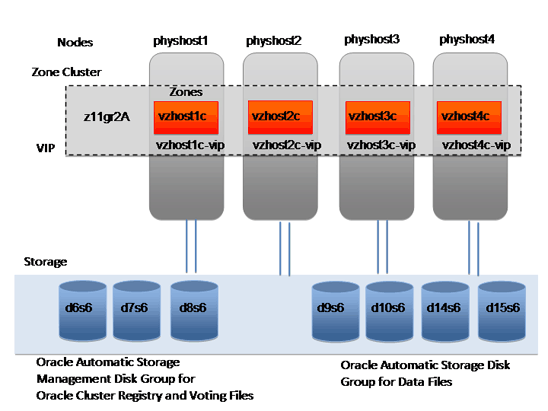
Figure 1. Four-Node Zone Cluster Configuration
Prerequisites
Ensure that the following prerequisites have been met:
- Oracle Solaris 11 build 175b or later with DNS and NIS name service is installed.
- Oracle Solaris Cluster 4.0 is installed with the
ha-cluster-fullpackage name. - Oracle Solaris Cluster 4.0 is configured.
-
Oracle Solaris 11 kernel parameters are configured in the
/etc/systemfile in the global zone. The following is an example of the recommended value: - Shared disks, also known as
/dev/did/rdskdevices, are known. Listing 1 is an example of how to identify a shared disk from the global zone of any cluster node: -
Oracle Virtual IP (VIP) and Single Client Access Name (SCAN) IP requirements have been allocated on the public network, for example:
vzhost1d, IP address 10.134.35.99, is used for the SCAN IP address.vzhost1c-vip, IP address 10.134.35.100, is used as the VIP address forvzhost1c.vzhost2c-vip, IP address 10.134.35.101, is used as the VIP address forvzhost2c.vzhost3c-vip, IP address 10.134.35.102, is used as the VIP address forvzhost3c.vzhost4c-vip, IP address 10.134.35.103, is used as the VIP address forvzhost4c.
Note: Do not manually plumb these IP addresses anywhere, including in the cluster, on the network.
-
There is an IPMP group for the public network with one active and one standby interface. Here is an example of an IPMP group called
sc_ipmp0.
shmsys:shminfo_shmmax 4294967295
set rlim_fd_cur=1024
   phyhost1# cldev status

=== Cluster DID Devices ===

Device Instance            Node               Status
---------------            ----               ------
/dev/did/rdsk/d1           phyhost1           Ok

/dev/did/rdsk/d10          phyhost1           Ok
                           phyhost2           Ok
                           phyhost3           Ok
                           phyhost4           Ok

/dev/did/rdsk/d14          phyhost1           Ok
                           phyhost2           Ok
                           phyhost3           Ok
                           phyhost4           Ok

/dev/did/rdsk/d15          phyhost1           Ok
                           phyhost2           Ok
                           phyhost3           Ok
                           phyhost4           Ok

/dev/did/rdsk/d16          phyhost1           Ok
                           phyhost2           Ok
                           phyhost3           Ok
                           phyhost4           Ok

/dev/did/rdsk/d17          phyhost1           Ok
                           phyhost2           Ok
                           phyhost3           Ok
                           phyhost4           Ok

/dev/did/rdsk/d18          phyhost1           Ok
                           phyhost2           Ok
                           phyhost3           Ok
                           phyhost4           Ok

/dev/did/rdsk/d19          phyhost2           Ok

/dev/did/rdsk/d2           phyhost1           Ok

/dev/did/rdsk/d20          phyhost2           Ok

/dev/did/rdsk/d21          phyhost3           Ok

/dev/did/rdsk/d22          phyhost3           Ok

/dev/did/rdsk/d23          phyhost4           Ok

/dev/did/rdsk/d24          phyhost4           Ok


/dev/did/rdsk/d6           phyhost1           Ok
                           phyhost2           Ok
                           phyhost3           Ok
                           phyhost4           Ok

/dev/did/rdsk/d7           phyhost1           Ok
                           phyhost2           Ok
                           phyhost3           Ok
                           phyhost4           Ok

/dev/did/rdsk/d8           phyhost1           Ok
                           phyhost2           Ok
                           phyhost3           Ok
                           phyhost4           Ok

/dev/did/rdsk/d9           phyhost1           Ok
                           phyhost2           Ok
                           phyhost3           Ok
                           phyhost4           Ok
Listing 1. Identifying a Shared Disk
The output shows that disks d6, d7, d8, d9, d10, d14, d15, d16, d17, and d18 are shared by phyhost1, phyhost2, phyhost3, and phyhost4.
The following shared disks will be used for the Oracle Automatic Storage Management disk group to store Oracle Cluster Registry and voting files:
/dev/did/rdsk/d6s6
/dev/did/rdsk/d7s6
/dev/did/rdsk/d8s6
The following shared disks will be used for the Oracle Automatic Storage Management disk group to store data files:
/dev/did/rdsk/d9s6
/dev/did/rdsk/d10s6
/dev/did/rdsk/d14s6
/dev/did/rdsk/d15s6
In this example, slice 6 is 102 GB in size. Please check the Oracle Grid Infrastructure Installation Guide for disk size requirements.
# ipmpstat -g
GROUP       GROUPNAME   STATE     FDT       INTERFACES
sc_ipmp0    sc_ipmp0    degraded  10.00s    net0 [net1]
Create the Zone Cluster
-
Use the
sysconfigtool to create a system configuration profile:
- Run the following command:
- Press F2 to go to the Network screen. Enter physhost1 as the computer name.
- Press F2 to continue to the DNS Name Service screen. Select Configure DNS.
- Press F2 to go to the DNS Server Addresses screen. Enter the IP address of the DNS server(s). At least one IP address is required, for example:
- Press F2 to go to the DNS Search List screen. Enter a list of domains to be searched when a DNS query is made. (If no domain is entered, only the DNS domain chosen for this system will be searched.) For example:
- Press F2 to go to the Alternate Name Service screen. From the list, select NIS.
- Press F2 to go to the screen where you can specify the domain name for the NIS name server. Specify the domain name using its exact capitalization and punctuation, for example:
- Press F2 to continue to the screen where you can specify how to find a name server for this system. Choose Find one to let the software search for a name server, or choose Specify one to specify a name server in a subsequent screen.
- Press F2 to continue to the Time Zone: Regions screen. Select the region that contains your time zone.
- Press F2 to continue to the Time Zone: Locations screen. Select the location that contains your time zone.
- Press F2 to continue to the Time Zone screen. Select your time zone.
- Press F2 to continue to the Users screen. Define a root password for the system and create a user account for yourself.
- Press F2 to continue to the System Configuration Summary screen. Review the list of all the settings.
- Press F2 to apply the settings.
-
Create a file called
zone.cfgwith the content shown in Listing 2: -
If the SCAN host name,
vzhost1d, resolves to multiple IP addresses, configure a separate global net resource for each IP address that the SCAN host name resolves to. For example, if the SCAN resolves to three IP addresses (10.134.35.97, 10.134.35.98, and 10.134.35.99), add the following global net resource to thezone.cfgfile. - As
root, run the commands shown in Listing 3 from one node to create the cluster:
# sysconfig create-profile -o /var/tmp/zc2.xml -g location,identity,naming_services,users<DNS Server IP address: 192.168.1.10 DNS Server IP address: 192.168.1.11Search domain: us.oracle.com Search domain: oracle.com Search domain:Domain Name: solaris.us.oracle.comThe software can find a name server only if that server is on the local subnet.
create
set zonepath=/export/zones/z11gR2A
set limitpriv ="default,proc_priocntl,proc_clock_highres"
add dedicated-cpu
set ncpus=16
end
add capped-memory
set physical=12g
set swap=12g
set locked=12g
end
add node
set physical-host=phyhost1
set hostname=vzhost1c
add net
set address=vzhost1c
set physical=e1000g0
end
end
add node
set physical-host=phyhost2
set hostname=vzhost2c
add net
set address=vzhost2c
set physical=e1000g0
end
end
add node
set physical-host=phyhost3
set hostname=vzhost3c
add net
set address=vzhost3c
set physical=e1000g0
end
end
add node
set physical-host=phyhost4
set hostname=vzhost4c
add net
set address=vzhost4c
set physical=e1000g0
end
end
add net
set address=vzhost1d
end
add net
set address=vzhost1c-vip
end
add net
set address=vzhost2c-vip
end
add net
set address=vzhost3c-vip
end
add net
set address=vzhost4c-vip
end
add device
set match="/dev/did/rdsk/d6s6"
end
add device
set match="/dev/did/rdsk/d7s6"
end
add device
set match="/dev/did/rdsk/d8s6"
end
add device
set match="/dev/did/rdsk/d9s6"
end
add device
set match="/dev/did/rdsk/d10s6"
end
add device
set match="/dev/did/rdsk/d14s6"
end
add device
set match="/dev/did/rdsk/d15s6"
end
add device
set match="/dev/did/rdks/d16s6"
end
add device
set match="/dev/did/rdsk/d17s6"
end
add device
set match="/dev/did/rdsk/d18s6"
end
Listing 2. Creating the
zone.cfgFileadd net set address=10.134.35.97 end add net set address=10.134.35.98 end add net set address=10.134.35.99 end# clzonecluster configure -f /var/tmp/zone.cfg z11gr2a # clzonecluster install -c /var/tmp/zc2.xml z11gr2A # clzonecluster status === Zone Clusters === --- Zone Cluster Status --- Name Node Name Zone HostName Status Zone Status ---- --------- ------------- ------ ----------- z11gr2A phyhost1 vzhost1c Offline Installed phyhost2 vzhost2c Offline Installed phyhost3 vzhost3c Offline Installed phyhost4 vzhost4c Offline Installed # clzc boot z11gr2A # clzc status === Zone Clusters === --- Zone Cluster Status --- Name Node Name Zone HostName Status Zone Status ---- --------- ------------- ------ ----------- z11gr2A phyhost1 vzhost1c Online Running phyhost2 vzhost2c Online Running phyhost3 vzhost3c Online Running phyhost4 vzhost4c Online RunningListing 3. Creating the Oracle Solaris Zone Cluster
Create the Oracle RAC Framework Resources for the Zone Cluster
As
root, perform the following steps from one node to create the Oracle RAC framework:-
Execute
clsetupfrom one global zone cluster node, as shown in Listing 4. - From one global zone cluster node, verify the Oracle RAC framework resources:
# /usr/cluster/bin/clsetup
*** Main Menu ***

    Please select from one of the following options:

       1) Quorum
        2) Resource groups
        3) Data Services
        4) Cluster interconnect
        5) Device groups and volumes
        6) Private hostnames
        7) New nodes
        8) Other cluster tasks

        ?) Help with menu options
        q) Quit

    Option:  3

 *** Data Services Menu ***

    Please select from one of the following options:

     * 1) Apache Web Server
     * 2) Oracle
     * 3) NFS
     * 4) Oracle Real Application Clusters
     * 5) SAP Web Application Server
     * 6) Highly Available Storage
     * 7) Logical Hostname
     * 8) Shared Address

      * ?) Help
      * q) Return to the Main Menu

    Option: 4

  *** Oracle Solaris Cluster Support for Oracle RAC ***

    Oracle Solaris Cluster provides a support layer for running Oracle
    Real Application Clusters (RAC) database instances. This option allows
    you to create the RAC framework resource group, storage resources,
    database resources and administer them, for managing the Oracle
    Solaris Cluster support for RAC.

    After the RAC framework resource group has been created, you can use
    the Oracle Solaris Cluster system administration tools to administer a
    RAC framework resource group that is configured on a global cluster.
    To administer a RAC framework resource group that is configured on a
    zone cluster, instead use the appropriate Oracle Solaris Cluster
    command.

   Is it okay to continue (yes/no) [yes]?

    Please select from one of the following options:

        1)  Oracle RAC Create Configuration
        2)  Oracle RAC Ongoing Administration

        q)  Return to the Data Services Menu

    Option:  1

   >>> Select Oracle Real Application Clusters Location <<<

    Oracle Real Application Clusters Location:

        1) Global Cluster
        2) Zone Cluster

    Option [2]:  2

   >>> Select Zone Cluster <<<

    From the list of zone clusters, select the zone cluster where you would like to
    configure Oracle Real Application Clusters.

        1) z11gr2A

        ?) Help
        d) Done

    Selected:  [z11gr2A]

   >>> Select Oracle Real Application Clusters Components to Configure <<<

    Select the component of Oracle Real Application Clusters that you are configuring:

        1) RAC Framework Resource Group
        2) Storage Resources for Oracle Files
        3) Oracle Clusterware Framework Resource
        4) Oracle Automatic Storage Management (ASM)
        5) Resources for Oracle Real Application Clusters Database Instances

    Option [1]: 1

   >>> Verify Prerequisites <<<


    This wizard guides you through the creation and configuration of the Real Application
    Clusters (RAC) framework resource group.

    Before you use this wizard, ensure that the following prerequisites are met:


    * All pre-installation tasks for Oracle Real Application Clusters are completed.

    * The Oracle Solaris Cluster nodes are prepared.

    * The data services packages are installed.

    * All storage management software that you intend to use is installed and configured
    on all nodes where Oracle Real Application Clusters is to run.


    Press RETURN to continue

   >>> Select Nodes <<<

    Specify, in order of preference, a list of names of nodes where Oracle Real
    Application Clusters is to run. If you do not explicitly specify a list, the list
    defaults to all nodes in an arbitrary order.


    The following nodes are available on the zone cluster z11skgxn:

       1) vzhost1c
       2) vzhost2c
       3) vzhost3c
       4) vzhost4c

       r) Refresh and Clear All
       a) All
       ?) Help
       d) Done

    Selected:  [vzhost1c, vzhost2c, vzhost3c, vzhost4c]
    Options:  d


   >>> Review Oracle Solaris Cluster Objects <<<


    The following Oracle Solaris Cluster objects will be created.

    Select the value you are changing:

          Property Name               Current Setting
          =============               ===============
        1) Resource Group Name        rac-framework-rg
        2) RAC Framework Resource N...rac-framework-rs

        d) Done
        ?) Help

    Option:  d

   >>> Review Configuration of RAC Framework Resource Group <<<


    The following Oracle Solaris Cluster configuration will be created.

    To view the details for an option, select the option.

                   Name                         Value
                   ====                         =====
        1) Resource Group Name        rac-framework-rg
        2) RAC Framework Resource N...rac-framework-rs

        c) Create Configuration
        ?) Help

    Option:  c
Listing 4. Executing
clsetup# clrs status -Z z11gr2A === Cluster Resources === Resource Name Node Name State Status Message ------------- --------- ----- -------------- rac-framework-rs vzhost1c Online Online vzhost2c Online Online vzhost3c Online Online vzhost4c Online OnlineSet Up the Root Environment in Zone Cluster
z11gr2AFrom each global zone cluster node (
phyhost1,phyhost2,phyhost3, andphyhost4), do the following:-
Log in to the non-global zone node and execute the following command as
root: - Include these paths in
.bash_profile: - Ensure
makeis installed on each zone cluster node:-
Check for the existence of the
makepackage on the node: -
If it doesn't exist, install the
makepackage by executing this command asroot:
# pkg list *make*# pkg install developer/build/make -
Check for the existence of the
- Make sure NTP is disabled but has dummy ntp.conf file so that Grid Infrastructure time synchronization service will run in Observer mode:
# /usr/sbin/zlogin z11gr2A [Connected to zone 'z11gr2A' pts/2] Last login: Thu Aug 25 17:30:14 on pts/2 Oracle Corporation SunOS 5.10 Generic Patch January 2005/u01/grid/product/11.2.0.3/bin /usr/cluster/bin# svcs ntp disabled Mar_28 svc:/network/ntp:default # cat > /etc/inet/ntp.conf slewalways yes disable pll ^DCreate a User and Group for the Oracle Software
-
As
root, execute the following commands from each node: - Include these paths in the
.bash_profilefile of the software owner,ouser: - Create a password for the software owner,
ouser: - As the software owner,
ouser, set up SSH from each node: - From the first node,
vzhost1c, do the following: - From second node,
vzhost2c, do the following: - From third node,
vzhost3c, do the following: - From fourth node,
vzhost4c, do the following: - From first node,
vzhost1c, do the following: - From each node, test the SSH setup:
- In each local zone cluster node, as
root, set up the Oracle Automatic Storage Management candidate disk: - In the local zone cluster, as the software owner, do the following from one node:
# groupadd -g 300 oinstall # groupadd -g 301 dba # useradd -g 300 -G 301 -u 302 -d /u01/ora_home -s /usr/bin/bash ouser # mkdir -p /u01/ora_home # chown ouser:oinstall /u01/ora_home # mkdir /u01/oracle # chown ouser:oinstall /u01/oracle # mkdir /u01/grid # chown ouser:oinstall /u01/grid # mkdir /u01/oraInventory # chown ouser:oinstall /u01/oraInventoryexport ORACLE_BASE=/u01/oracle export ORACLE_HOME=/u01/oracle/product/11.2.0.3 export AWT_TOOLKIT=XToolkit# passwd ouser New Password: Re-enter new Password: passwd: password successfully changed for ouser bash-3.00#$ ssh-keygen -t rsa Generating public/private rsa key pair. Enter file in which to save the key (/u01/ora_home/.ssh/id_rsa): Enter passphrase (empty for no passphrase): Enter same passphrase again: Your identification has been saved in /u01/ora_home/.ssh/id_rsa. Your public key has been saved in /u01/ora_home/.ssh/id_rsa.pub. The key fingerprint is: e6:63:c9:71:fe:d1:8f:71:77:70:97:25:2a:ee:a9:33 local1@vzhost1c $ $ pwd /u01/ora_home/.ssh$ cd /u01/ora_home/.ssh $ cat id_rsa.pub >> authorized_keys $ chmod 600 authorized_keys $ scp authorized_keys vzhost2c:/u01/ora_home/.ssh$ cd /u01/ora_home/.ssh $ cat id_rsa.pub >> authorized_keys $ scp authorized_keys vzhost3c:/u01/ora_home/.ssh$ cd /u01/ora_home/.ssh $ cat id_rsa.pub >> authorized_keys $ scp authorized_keys vzhost4c:/u01/ora_home/.ssh$ cd /u01/ora_home/.ssh $ cat id_rsa.pub >> authorized_keys $ scp authorized_keys vzhost1c:/u01/ora_home/.ssh$ cd /u01/ora_home/.ssh $ scp authorized_keys vzhost2c:/u01/ora_home/.ssh $ scp authorized_keys vzhost3c:/u01/ora_home/.ssh$ ssh vzhost1c date $ ssh vzhost2c date $ ssh vzhost3c date $ ssh vzhost4c date# for i in 6 7 8 9 10 14 15 > do > chown ouser:oinstall /dev/did/rdsk/d${i}s6 > chmod 660 /dev/did/rdsk/d${i}s6 > done$ for i in 6 7 8 9 10 14 15 > do > dd if=/dev/zero of=/dev/did/rdsk/d${i}s6 bs=1024k count=200 > doneInstall Oracle Grid Infrastructure 11.2.0.3 in the Oracle Solaris Zones Cluster Nodes
- As the software owner, execute the commands shown in Listing 5 on one node:
- Type y to continue.
- Provide the following input to Oracle Universal Installer:
- On the Select Installation Option page, select Install and Configure Oracle Grid Infrastructure for a Cluster.
- On the Select Installation Type page, select Advanced Installation.
- On the Select Product Languages page, select English.
-
On the Grid Plug and Play Information page, specify the following, as shown in Figure 2.
- For Cluster Name, specify vzhost-cluster.
- For SCAN Name, specify vzhost1d.
- For SCAN Port, specify 1521.
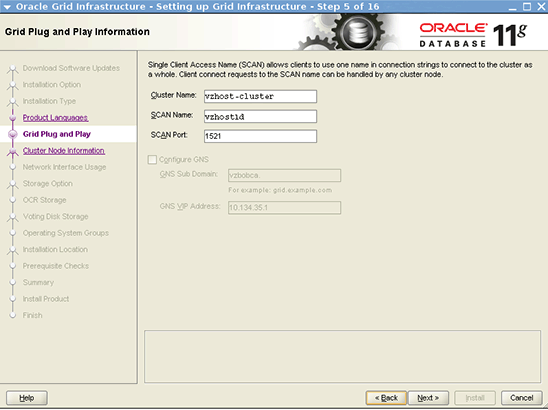
Figure 2. Grid Plug and Play Information Page - On the Cluster Node Information page, specify the following, as shown in Figure 3:
- On the Network Interface Usage page, accept the default settings.
- On the Storage Option Information page, select Oracle Automatic Storage Management.
-
On the Create ASM Disk Group page, do the following, as shown in Figure 4:
- Click the Change Discovery Path button and add /dev/did/rdsk/d*s6 for the disk discovery path.
- For Disk Group Name, specify crsdg.
- Select Candidate Disks, and then select /dev/did/rdsk/d6s6, /dev/did/rdsk/d7s6, and /dev/did/rdsk/d8s6.
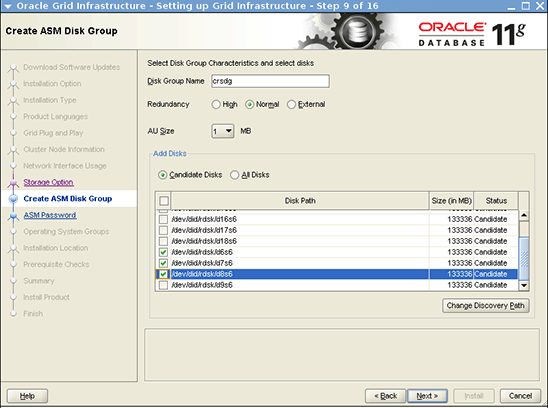
Figure 4. Create ASM Disk Group Page - On the Specify ASM Password page, shown in Figure 5, enter the SYS and ASMSNMP accounts' username and password.
-
On the Privileged Operating System Groups page, use the default settings:
- For Oracle ASM DBA (OSDBA for ASM) Group, select oinstall.
- Optionally, for Oracle ASM Operator (OSOPER for ASM) Group (Optional), select a group.
- For Oracle ASM Administrator (OSASM) Group, select oinstall.
-
On the Software Installation Location page, specify the following:
- For Oracle Base, specify /u01/oracle.
- For Software Location, specify /u01/grid/product/11.2.0.3.
- On the Create Inventory page, select /u01/oraInventory for Inventory Directory.
- On the Perform Prerequisite Checks page, select Ignore All, as shown in Figure 6:
- On the Summary page, click Install to start the software installation.
-
Open a terminal window and execute the script as
rooton each zone cluster node. Listing 6 shows an example. - After executing both scripts on the last node, click OK in the GUI to continue.
- Click OK, then click Skip, and then click Next to continue.
- Click Yes to continue.
- From any node, check the status of Oracle Grid Infrastructure resources, as shown in Listing 7:
-
Correct the Oracle Grid Infrastructure time zone:
- Stop Oracle High Availability Services on all zone cluster nodes:
- Find the system's time zone by performing the following on each zone cluster node:
- Change the value of
TZin$GRID_HOME/crs/install/s_crsconfig_<nodename>_env.txtto match the system's time zone. In this example, it isTZ=US/Pacific. - Restart the services:
# crsctl stop crs# svccfg -s timezone:default listprop timezone/localtime timezone/localtime astring US/Pacific# crsctl start crs
$ bash
$ export DISPLAY=<hostname>:<n>
$ cd <PATH to 11.2.0.3 based software image>/grid/
$ ./runInstaller
starting Oracle Universal Installer...

Checking Temp space: must be greater than 180 MB.   Actual 20766 MB    Passed
Checking swap space: must be greater than 150 MB.   Actual 23056 MB    Passed
Checking monitor: must be configured to display at least 256 colors
    >>> Could not execute /usr/bin/xdpyinfo    Failed <<<<

Some requirement checks failed. You must fulfill these requirements before
continuing with the installation,

Continue? (y/n) [n]
Listing 5. Starting Oracle Universal Installer
Public Hostname Virtual Hostname vzhost1cvzhost1c-vipvzhost2cvzhost2c-vipvzhost3cvzhost3c-vipvzhost4cvzhost4c-vip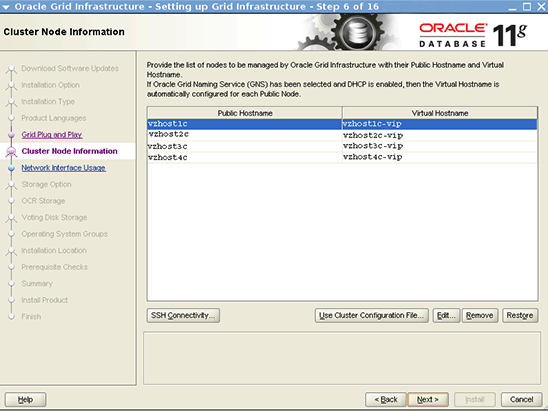
Figure 3. Cluster Node Information Page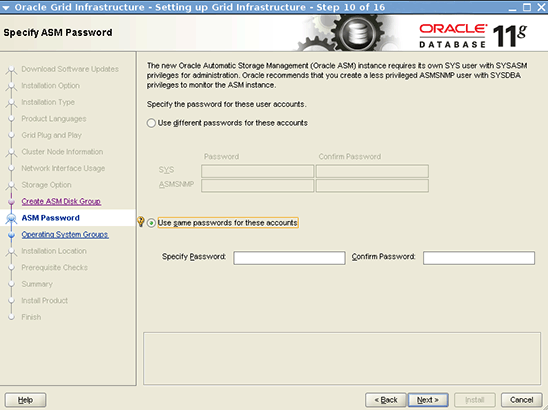
Figure 5. Specify ASM Password Page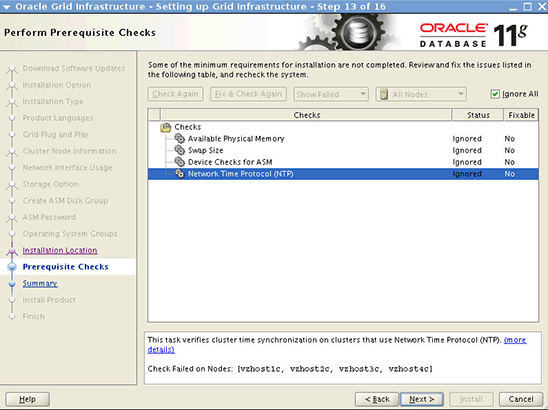
Figure 6. Perform Prerequisite Checks PageThe Execute Configuration Scripts dialog box, shown in Figure 7, asks you to execute the
/u01/oraInventory/orainstRoot.shand/u01/grid/product/11.2.0.3/root.shscripts asroot.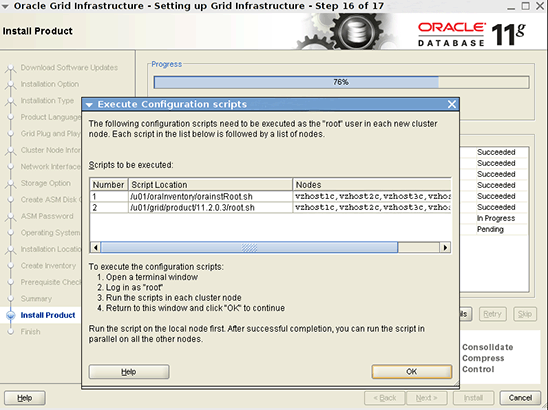
Figure 7. Message About Executing Configuration Scripts# /u01/oraInventory/orainstRoot.sh Changing permissions of /u01/oraInventory. Adding read,write permissions for group. Removing read,write,execute permissions for world. Changing groupname of /u01/oraInventory to oinstall. The execution of the script is complete. # cd /u01/grid/product/11.2.0.3 #./root.sh Performing root user operation for Oracle 11g The following environment variables are set as: ORACLE_OWNER= ouser ORACLE_HOME= /u01/grid/product/11.2.0.3 Enter the full pathname of the local bin directory: [/usr/local/bin]: /opt/local/bin Creating /opt/local/bin directory... Copying dbhome to /opt/local/bin ... Copying oraenv to /opt/local/bin ... Copying coraenv to /opt/local/bin ... Creating /var/opt/oracle/oratab file... Entries will be added to the /var/opt/oracle/oratab file as needed by Database Configuration Assistant when a database is created Finished running generic part of root script. Now product-specific root actions will be performed. Using configuration parameter file: /u01/grid/product/11.2.0.3/crs/install/crsconfig_params Creating trace directory User ignored Prerequisites during installation OLR initialization - successful root wallet root wallet cert root cert export peer wallet profile reader wallet pa wallet peer wallet keys pa wallet keys peer cert request pa cert request peer cert pa cert peer root cert TP profile reader root cert TP pa root cert TP peer pa cert TP pa peer cert TP profile reader pa cert TP profile reader peer cert TP peer user cert pa user cert Adding Clusterware entries to inittab CRS-2672: Attempting to start 'ora.mdnsd' on 'vzhost1c' CRS-2676: Start of 'ora.mdnsd' on 'vzhost1c' succeeded CRS-2672: Attempting to start 'ora.gpnpd' on 'vzhost1c' CRS-2676: Start of 'ora.gpnpd' on 'vzhost1c' succeeded CRS-2672: Attempting to start 'ora.cssdmonitor' on 'vzhost1c' CRS-2672: Attempting to start 'ora.gipcd' on 'vzhost1c' CRS-2676: Start of 'ora.cssdmonitor' on 'vzhost1c' succeeded CRS-2676: Start of 'ora.gipcd' on 'vzhost1c' succeeded CRS-2672: Attempting to start 'ora.cssd' on 'vzhost1c' CRS-2672: Attempting to start 'ora.diskmon' on 'vzhost1c' CRS-2676: Start of 'ora.diskmon' on 'vzhost1c' succeeded CRS-2676: Start of 'ora.cssd' on 'vzhost1c' succeeded ASM created and started successfully. Disk Group crsdg created successfully. clscfg: -install mode specified Successfully accumulated necessary OCR keys. Creating OCR keys for user 'root', privgrp 'root'.. Operation successful. CRS-4256: Updating the profile Successful addition of voting disk 621725b80bf24f53bfc8c56f8eaf3457. Successful addition of voting disk 630c40e735134f2bbf78571ea35bb856. Successful addition of voting disk 4a78fd6ce8564fdbbfceac0f0e9d7c37. Successfully replaced voting disk group with +crsdg. CRS-4256: Updating the profile CRS-4266: Voting file(s) successfully replaced ## STATE File Universal Id File Name Disk group -- ----- ----------------- --------- --------- 1. ONLINE 621725b80bf24f53bfc8c56f8eaf3457 (/dev/did/rdsk/d6s6) [CRSDG] 2. ONLINE 630c40e735134f2bbf78571ea35bb856 (/dev/did/rdsk/d7s6) [CRSDG] 3. ONLINE 4a78fd6ce8564fdbbfceac0f0e9d7c37 (/dev/did/rdsk/d8s6) [CRSDG] Located 3 voting disk(s). CRS-2672: Attempting to start 'ora.asm' on 'vzhost1c' CRS-2676: Start of 'ora.asm' on 'vzhost1c' succeeded CRS-2672: Attempting to start 'ora.CRSDG.dg' on 'vzhost1c' CRS-2676: Start of 'ora.CRSDG.dg' on 'vzhost1c' succeeded Configure Oracle Grid Infrastructure for a Cluster ... succeededListing 6. Executing the Scripts
An error message,
[INS-20802] Oracle Cluster Verification Utility failed, appears, as shown in Figure 8. TheoraInstalllog also shows errors regarding thentp.confsetting that are not applicable to Oracle Solaris 11.INFO: Check for NTP daemon or service alive passed on all nodes INFO: NTP daemon slewing option check failed on some nodes INFO: Check failed on nodes: INFO: vzgray2a,vzgray3a,vzgray4a,vzgray1a INFO: PRVF-5436 : The NTP daemon running on one or more nodes lacks the slewing option "'slewalways yes' & 'disable pll'" INFO: Clock synchronization check using Network Time Protocol(NTP) failed INFO: PRVF-9652 : Cluster Time Synchronization Services check failed INFO: Checking VIP configuration. INFO: Checking VIP Subnet configuration. INFO: Check for VIP Subnet configuration passed. INFO: Checking VIP reachability INFO: Check for VIP reachability passed. INFO: Post-check for cluster services setup was unsuccessful on all the nodes. INFO: WARNING: INFO: Completed Plugin named: Oracle Cluster Verification Utility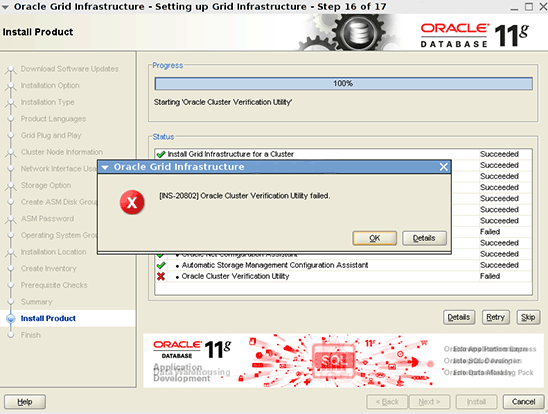
Figure 8. Error MessageError message INS-32091 appears, as shown in Figure 9:
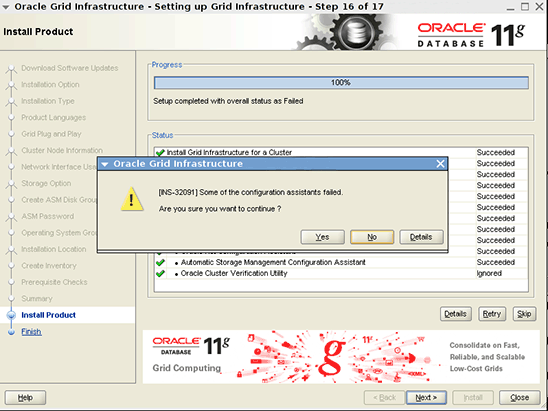
Figure 9. Another Error MessageThe installation of Oracle Grid Infrastructure 11.2.0.3 is completed.
# /u01/grid/product/11.2.0.3/bin/crsctl status res -t
--------------------------------------------------------------------------------
NAME           TARGET  STATE        SERVER                   STATE_DETAILS
--------------------------------------------------------------------------------
Local Resources
--------------------------------------------------------------------------------
ora.CRSDG.dg
               ONLINE  ONLINE       vzhost1c
               ONLINE  ONLINE       vzhost2c
               ONLINE  ONLINE       vzhost3c
               ONLINE  ONLINE       vzhost4c
ora.LISTENER.lsnr
               ONLINE  ONLINE       vzhost1c
               ONLINE  ONLINE       vzhost2c
               ONLINE  ONLINE       vzhost3c
               ONLINE  ONLINE       vzhost4c
ora.asm
               ONLINE  ONLINE       vzhost1c               Started
               ONLINE  ONLINE       vzhost2c               Started
               ONLINE  ONLINE       vzhost3c               Started
               ONLINE  ONLINE       vzhost4c               Started
ora.gsd
               OFFLINE OFFLINE      vzhost1c
               OFFLINE OFFLINE      vzhost2c
               OFFLINE OFFLINE      vzhost3c
               OFFLINE OFFLINE      vzhost4c
ora.net1.network
               ONLINE  ONLINE       vzhost1c
               ONLINE  ONLINE       vzhost2c
               ONLINE  ONLINE       vzhost3c
               ONLINE  ONLINE       vzhost4c
ora.ons
               ONLINE  ONLINE       vzhost1c
               ONLINE  ONLINE       vzhost2c
               ONLINE  ONLINE       vzhost3c
               ONLINE  ONLINE       vzhost4c
--------------------------------------------------------------------------------
Cluster Resources
--------------------------------------------------------------------------------
ora.LISTENER_SCAN1.lsnr
      1        ONLINE  ONLINE       vzhost1c
ora.cvu
      1        ONLINE  ONLINE       vzhost2c
ora.oc4j
      1        ONLINE  ONLINE       vzhost3c
ora.scan1.vip
      1        ONLINE  ONLINE       vzhost4c
ora.vzhost1c.vip
      1        ONLINE  ONLINE       vzhost1c
ora.vzhost2c.vip
      1        ONLINE  ONLINE       vzhost2c
ora.vzhost3c.vip
      1        ONLINE  ONLINE       vzhost3c
ora.vzhost4c.vip
      1        ONLINE  ONLINE       vzhost4c
Listing 7. Checking the Status of the Resources
Install Oracle Database 11.2.0.3 and Create the Database
-
Execute the following commands to launch the ASM Configuration Assistant, where you can create a disk group called
swbdgfor the database creation. - In the ASM Configuration Assistant, do the following:
- In the Disk Groups tab, shown in Figure 10, click Create.
-
In the Create Disk Group page, shown in Figure 11, do the following:
- For Disk Group Name, specify swbdg.
- Select /dev/did/rdsk/d9s6, /dev/did/rdsk/d10s6, /dev/did/rdsk/d14s6, and /dev/did/rdsk/d15s6.
- Specify fgr1 as the Failure Group for disks
/dev/did/rdsk/d9s6and/dev/did/rdsk/d10s6. - Specify fgr2 as the Failure Group for disks
/dev/did/rdsk/d14s6and/dev/did/rdsk/d15s6. - Click OK to create the disk group.
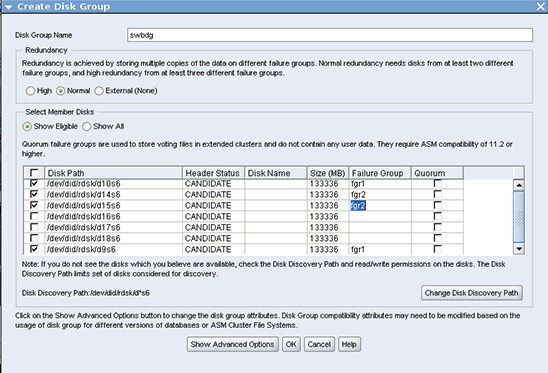
Figure 11. Create Disk Group Page - After the
swbdgdisk group creation is completed, click Exit to close the ASM Configuration Assistant.
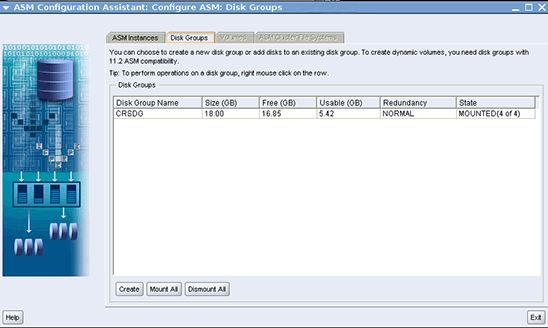
Figure 10. ASM Configuration Assistant - From one node, run the commands shown in Listing 8 to open the Oracle Universal Installer to install Oracle Database:
- Type y to continue.
-
Provide input to the Oracle Universal Installer, as follows:
- Provide the requested information on the Configuration Security Updates page and the Download Software Updates page.
- On the Select Installation Option page, select Create and configure a database.
- On the System Class page, select Server Class.
-
On the Grid Installation Options page, shown in Figure 12, do the following:
- Select Oracle Real Application Clusters database installation.
- Ensure all nodes are selected.
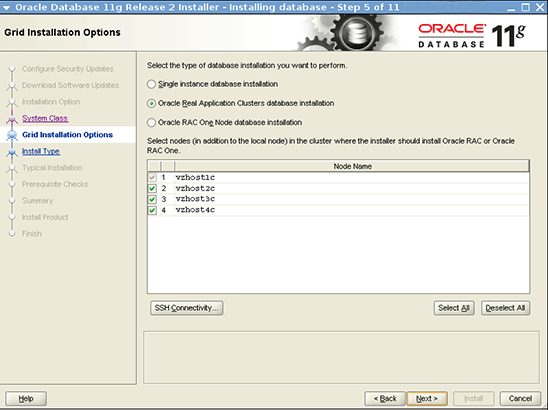
Figure 12. Grid Installation Options Page - On the Select Install Type page, select Advanced install.
- On the Select Product Languages page, use the default value.
- On the Select Database Edition page, select Enterprise Edition.
-
On the Specify Installation Location page, specify the following:
- For Oracle Base, select /u01/oracle.
- For Software Location, select /u01/oracle/product/11.2.0.3.
- On the Select Configuration Type page, select General Purpose/Transaction Processing.
-
On the Specify Database Identifiers page, specify the following:
- For Global Database Name, specify swb.
- For Oracle Service Identifier, specify swb.
- On the Specify Configuration Options page, shown in Figure 13, use the default settings.
- On the Specify Management Options page, use the default settings.
-
On the Specify Database Storage Options page, do the following:
- Select Oracle Automatic Storage Management.
- Specify the password for the ASMSNMP user.
- On the Specify Recovery Options page, select Do not enable automated backups.
-
On the Select ASM Disk Group page, shown in Figure 14, select SWBDG.
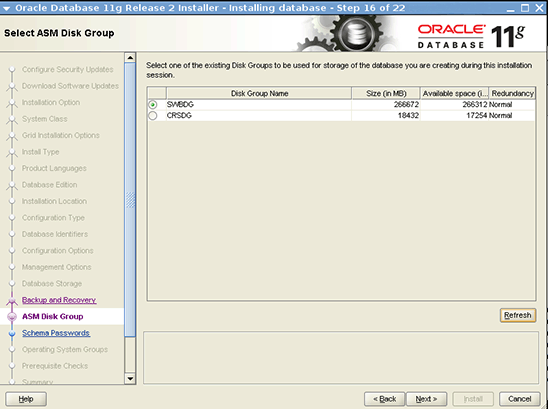
Figure 14. Select ASM Disk Group Page - On the Specify Schema Passwords page, specify password for the SYS, SYSTEM, SYSMAN, and DBSNMP accounts.
-
On the Privileged Operating System Groups page, specify the following:
- For Database Administrator (OSDBA) Group, select dba.
- For Database Operator (OSOPER) Group (Optional), select oinstall.
- On the Perform Prerequisite Checks page, shown in Figure 15, select Ignore All.
- Select Yes to continue.
- On the Summary page, shown in Figure 17, click Install.
- In the Database Configuration Assistant dialog box, shown in Figure 18, click OK to continue.
-
After executing the
root.shscript on the last node, click OK to continue.

Figure 13. Specify Configuration Options Page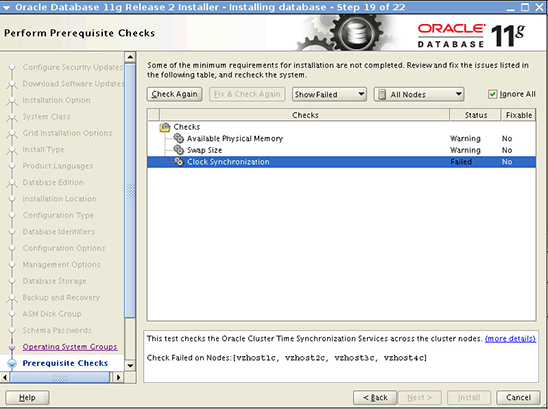
Figure 15. Perform Prerequisite Checks PageAn INS-13016 message appears, as shown in Figure 16.
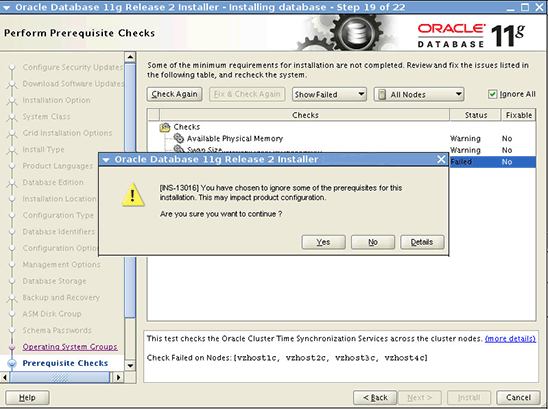
Figure 16. Error Message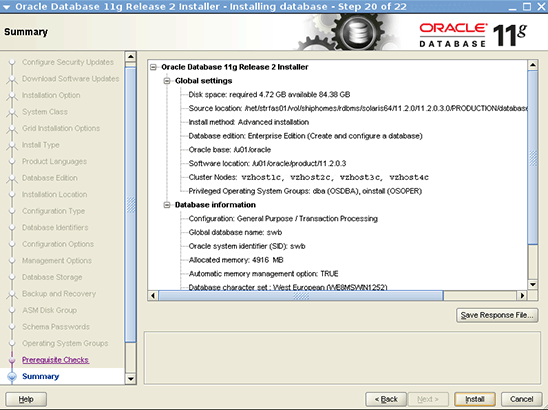
Figure 17. Summary Page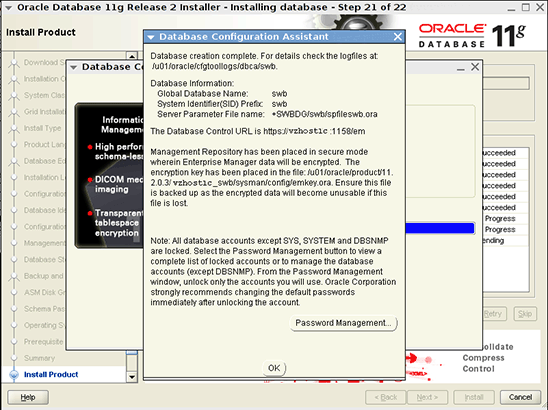
Figure 18. Database Configuration Assistant Dialog BoxThe Execute Configuration Scripts dialog box asks you to execute
root.shon each node, as shown in Figure 19.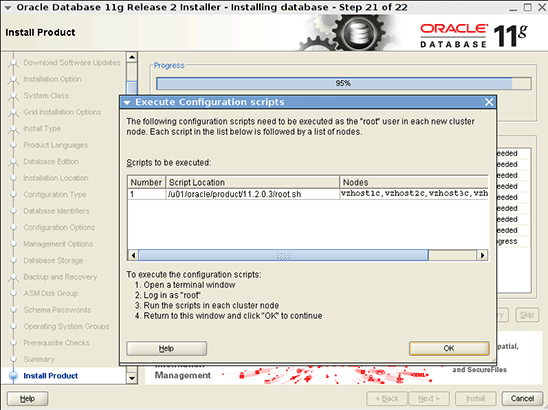
Figure 19. Execute Configuration Scripts Dialog BoxThe Finish page, shown in Figure 20, shows that the installation and configuration of Oracle Database is complete.
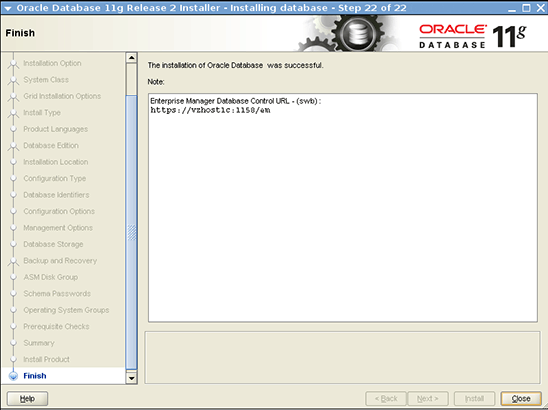
Figure 20. Finish Page
$ export DISPLAY=<hostname>:<n> $ /u01/grid/product/11.2.0.3/bin/asmca$ export DISPLAY=<hostname>:<n> $ cd <PATH to 11.2.0.3 based software image>/database $ ./runInstaller starting Oracle Universal Installer... Checking Temp space: must be greater than 180 MB. Actual 20766 MB Passed Checking swap space: must be greater than 150 MB. Actual 23056 MB Passed Checking monitor: must be configured to display at least 256 colors >>> Could not execute /usr/bin/xdpyinfo Failed <<<< Some requirement checks failed. You must fulfill these requirements before continuing with the installation, Continue? (y/n) [n]Listing 8. Starting Oracle Universal Installer
Create the Oracle Solaris Cluster Resources
Use the following procedure to create the Oracle Solaris Cluster resource. Alternatively, you can use the
clsetupwizard.-
From one zone cluster node, execute the following command to register the
SUNW.crs_frameworkresource type in the zone cluster: -
Add an instance of the
SUNW.crs_frameworkresource type to the Oracle RAC framework resource group: - Register the scalable Oracle Automatic Storage Management instance proxy resource type:
- Register the Oracle Automatic Storage Management disk group resource type:
-
Create resource groups
asm-inst-rgandasm-dg-rg: -
Set a strong positive affinity on
rac-fmwk-rgbyasm-inst-rg: -
Set a strong positive affinity on
asm-inst-rgbyasm-dg-rg: -
Create a
SUNW.scalable_asm_instance_proxyresource and set the resource dependencies: - Add an Oracle Automatic Storage Management disk group resource type to the
asm-dg-rgresource group: - On a cluster node, bring online the
asm-inst-rgresource group in a managed state: -
On a cluster node, bring online the
asm-dg-rgresource group in a managed state:
# clrt register SUNW.crs_framework# clresource create -t SUNW.crs_framework \ -g rac-framework-rg \ -p resource_dependencies=rac-framework-rs \ crs-framework-rs# clresourcetype register SUNW.scalable_asm_instance_proxy# clresourcetype register SUNW.scalable_asm_diskgroup_proxy# clresourcegroup create -S asm-inst-rg asm-dg-rg# clresourcegroup set -p rg_affinities=++rac-framework-rg asm-inst-rg# clresourcegroup set -p rg_affinities=++asm-inst-rg asm-dg-rg# clresource create asm-inst-rg \ -t SUNW.scalable_asm_instance_proxy \ -p ORACLE_HOME=/u01/grid/product/11.2.0.3 \ -p CRS_HOME=/u01/grid/product/11.2.0.3 \ -p "ORACLE_SID{vzhost1c}"=+ASM1 \ -p "ORACLE_SID{vzhost2c}"=+ASM2 \ -p "ORACLE_SID{vzhost3c}"=+ASM3 \ -p "ORACLE_SID{vzhost4c}"=+ASM4 \ -p resource_dependencies_offline_restart=crs-framework-rs \ -d asm-inst-rs# clresource create -g asm-dg-rg -t SUNW.scalable_asm_diskgroup_proxy \ -p asm_diskgroups=CRSDG,SWBDG \ -p resource_dependencies_offline_restart=asm-inst-rs \ -d asm-dg-rs# clresourcegroup online -eM asm-inst-rg
<# clresourcegroup online -eM asm-dg-rg# clresourcegroup create -S \ -p rg_affinities=++rac-framework-rg,++asm-dg-rg \ rac-swbdb-rg - Register the
SUNW.scalable_rac_server_proxyresource type: - Add a database resource to the resource group:
- Bring the resource group online:
- Check the status of the cluster resource , as shown in Listing 9:

# clresourcetype register SUNW.scalable_rac_server_proxy
# clresource create -g rac-swbdb-rg \
-t SUNW.scalable_rac_server_proxy \
-p resource_dependencies=rac-framework-rs \
-p resource_dependencies_offline_restart=crs-framework-rs,asm-dg-rs \
-p oracle_home=/u01/oracle/product/11.2.0.3 \
-p crs_home=/u01/grid/product/11.2.0.3 \
-p db_name=swb \
-p "oracle_sid{vzhost1c}"=swb1 \
-p "oracle_sid{vzhost2c}"=swb2 \
-p "oracle_sid{vzhost3c}"=swb3 \
-p "oracle_sid{vzhost4c}"=swb4 \
-d rac-swb-srvr-proxy-rs
# clresourcegroup online -emM rac-swbdb-rg
# clrs status

=== Cluster Resources ===

Resource Name             Node Name      State      Status Message
-------------             ---------      -----      --------------
crs_framework-rs          vzhost1c       Online     Online
                          vzhost2c       Online     Online
                          vzhost3c       Online     Online
                          vzhost4c       Online     Online

rac-framework-rs          vzhost1c       Online     Online
                          vzhost2c       Online     Online
                          vzhost3c       Online     Online
                          vzhost4c       Online     Online

asm-inst-rs               vzhost1c       Online     Online - +ASM1 is UP and ENABLED
                          vzhost2c       Online     Online - +ASM2 is UP and ENABLED
                          vzhost3c       Online     Online - +ASM3 is UP and ENABLED
                          vzhost4c       Online     Online - +ASM4 is UP and ENABLED

asm-dg-rs                 vzhost1c       Online     Online - Mounted: SWBDG
                          vzhost2c       Online     Online - Mounted: SWBDG
                          vzhost3c       Online     Online - Mounted: SWBDG
                          vzhost4c       Online     Online - Mounted: SWBDG

rac-swb-srvr-proxy-rs     vzhost1c       Online     Online - Oracle instance UP
                          vzhost2c       Online     Online - Oracle instance UP
                          vzhost3c       Online     Online - Oracle instance UP
                          vzhost4c       Online     Online - Oracle instance UP
Listing 9. Checking the Cluster Resource Status
See Also
Here are some additional resources:
- "Managing DNS Tasks" in the Oracle Solaris Administration: Naming and Directory Services guide: http://docs.oracle.com/cd/E23824_01/html/821-1455/dnsadmin-1.html#scrolltoc
- "Managing the Name Service Switch" in the Oracle Solaris Administration: Naming and Directory Services guide: http://docs.oracle.com/cd/E23824_01/html/821-1455/dnsadmin-1.html#scrolltoc
- Oracle Solaris Cluster 4.0 documentation library: http://www.oracle.com/solaris/technologies/cluster-documentation.html
- All Oracle Solaris Cluster technical resources: http://www.oracle.com/solaris/technologies/cluster-technical-resources.html
- Oracle Solaris Cluster 4.0 Release Notes: http://docs.oracle.com/cd/E23623_01/html/E23438/index.html
- Oracle Solaris patches and updates: http://www.oracle.com/middleware/technologies/cluster-archive.html
- Oracle Solaris Cluster downloads: https://www.oracle.com/middleware/technologies/solaris-cluster-downloads.html
- Oracle Solaris Cluster training: http://www.oracle.com/solaris/technologies/cluster-overview.html
About the Author
Vinh Tran is a quality engineer in the Oracle Solaris Cluster Group. His responsibilities include, but are not limited to, certification and qualification of Oracle RAC on Oracle Solaris Cluster.
Revision 2.0, 06/05/2014
Revision 1.0, 07/27/2012